The following email was sent to the coaches of Infinity SC on Wednesday, February 22nd.
Infinity SC Coaches,
I hope that you all enjoyed the three day weekend! I got to watch a lot of great Infinity SC Soccer in Las Vegas, Mesquite and St. George this past weekend. I was thrilled at the way our teams played. There was not a game that I watched where the Infinity SC team was not trying to be the better possession team and being successful at it. The combination play, movement off the ball, personal creativity and teamwork was very impressive everywhere I looked! However, there is a big weakness in our games club wide...
...As I was taking notes I kept writing down... need to improve shooting strength/technique and help our players understand how to finish. As well as we possess and as pretty of soccer it is that we play we are not scoring goals. I believe that we play intelligent and attractive soccer, but we are missing the final touch that makes it all "productive." I will be generating a curriculum for the Spring that will emphasize shooting and finishing(please view the video). Obviously this is NOT all I want you to do in your sessions, but I would like for every team to start emphasizing it more than you have in the past.
I would like to congratulate Katijo Rasmussens u9 Blue Girls for being President's Cup Champions, Katie Taylor's u14 Premier Girls & Anthony Larson's u15 Select Girls for being Ice Breaker Tournament Champion! All of the teams that participated in tournament play this past weekend represented our club and community well!
The following video should be viewed by every one of our coaches, players and parents. Please spend some time watching the following clip form a recent interview with U.S. Men's National team head coach Jurgen Klinsmann.
The full interview can be viewed here: http://youtu.be/o1TWEoSmRwU
I am truly grateful for everything that each of you do! We have a very busy Spring and Summer awaiting us. Let's be prepared for it!
Last thing... I NEED YOU TO ENCOURAGE YOUR PLAYERS/PARENTS TO SEND PICTURES FOR OUR SLIDE SHOW TO: coachjginn.photos@picasaweb.com
-Ginn
Follow the progress of "Score More Goals" at www.infinitysc.com
Friday, February 24, 2012

Tuesday, February 7, 2012
Local soccer team shines in Mesquite - The Herald Journal: Sports
Local soccer team shines in Mesquite - The Herald Journal: Sports: When talking about her U15 girls soccer team, head coach Sherri
Dever asserted:
Dever asserted:
Parents driving coaches away from game
Written by
Patrick Hite
Columnist
Rob Bennett has one less job these days. The Covington High School science teacher, who is also the city's mayor, resigned as the school's boys' basketball coach in late January.
Enough was enough.
Over the past 20 years Bennett has spent time as both the boys' and girls' basketball coach and, for the most part, had support from parents and fans.
After taking some time off to get his master's degree, he returned to the bench four years ago. In the time away from the game something changed. That support he received in the past was gone. Bennett and his coaching staff were questioned by parents about something after every game.
"It was either over playing time, what I said to their child on the bench, why they didn't start, why they didn't play in this quarter, why did you play this player because he missed practice or missed 30 minutes of practice because he went to get tutored in English, why did you keep a freshman on the varsity," Bennett said. "It was unbelievable."
There were even parents who accused Bennett of allowing poor behavior and language on the team bus, accusations that were proved false with the help of videotape.
Said Bennett, "Why am I going to be miserable doing something I love to do and, for the most part, was pretty good at?"
Unfortunately, Bennett's story isn't unique. There are plenty of stories of coaches quitting because they are tired of putting up with unreasonable parents and fans.
Ironically, Nathan Hale, the Covington assistant coach who has taken over the team for the remainder of the season, has been close to a similar situation in the past. His father, Bill Hale, was driven out by parents as Fort Defiance boys' basketball coach more than a decade ago.
In 2003, Mike Hamilton, the girls' basketball coach at Rockbridge County, even went as far as suing a troublesome parent.
Go to any high school basketball game and you can't avoid it. The other night, while covering the Rockbridge County at Waynesboro boys' basketball game, I sat in front of two Rockbridge County fans who complained about the officials almost every trip down the court. I should have known what I was in for when, before the game started, one of the ladies pointed to an official and said, "That's the one who threw me out of a game at Wilson Memorial."
Earlier this year, during a Stuarts Draft-Waynesboro game, I heard a parent of a Waynesboro player wishing out loud that her team played more like Stuarts Draft, who runs an up-tempo style. I guess it didn't matter that Waynesboro has gone to back-to-back state tournaments, including a spot in last year's state championship game.
Wilson Memorial athletic director Greg Troxell has been trying to figure out why there have been so many problems with fans and parents lately.
"Is it what I call the ESPN factor?" Troxell said. "Everyone watches ESPN and hears how it should be done and now everyone is an expert. Is it parents trying to live their youth again through their kids? Is it economic pressure and the hope that their kid is going to get a full ride to college and save them money? I don't know, but it is getting worse, and the lack of respect for officials and coaches is alarming."
Steve Hartley offered another possibility.
"With so many different little leagues in the country now, parents are having to coach more than they used to," the Stuarts Draft athletic director said. "In turn, they seem to think they have more knowledge of the game."
Of course, none of the parents and fans who are actually causing problems will recognize themselves when reading this. It's probably too much to ask that all spectators cheer for their teams without criticizing officials, coaches or the opposing players.
When kids see their parents blaming everyone else for their team's lack of success, it's bound to affect them.
"The kids see this and are just a product of their environment," Bennett said. "Parents do not tell the truth to their kids like we coaches do. We now live in a politically correct world and people are not used to hearing the truth. They want to not face what is real and make excuses when things do not go their way. Rules are wonderful until they affect my kid. Then we want something else to be done."
School administrators try to solve the problems. Larry Landes, Fort Defiance's principal, said his staff has spoken in private to fans who act inappropriately. The topic is raised at all meet-the-team nights prior to the season, and administrators are at almost all athletic events, ready to step in and handle any problems.
"Use of profanity from fans, screaming at officials, belittling coaches is totally unacceptable," Landes said. "We preach sportsmanship with athletes, coaches and fans."
Not only are coaches quitting, but schools are finding it more and more difficult to get someone to coach in the first place.
Even athletes are giving up. A couple of years ago there was an athlete at Wilson Memorial who chose not to play because he was tired of his dad yelling at him from the stands. Troxell offered to talk to the father, but the kid said it wouldn't change anything.
"What parentsdon't realize is they are really embarrassing their child," said Troxell, who emphasized that a majority of fans are great, but it only takes one or two to make everyone look bad.
I've often said, only half jokingly, that high-school sporting events would be better if they were played without anyone in the stands. Obviously, no one wants to reach that point. Instead, it's time for the adults who are watching the games to grow up and actually act like adults.
"No coaches or officials are trying to cheat or do things to kids on purpose," Hartley said. "So just sit back and enjoy the game."
Original Article can Be Read at http://www.newsleader.com/article/20120205/SPORTS/202050332
Patrick Hite
Columnist
Rob Bennett has one less job these days. The Covington High School science teacher, who is also the city's mayor, resigned as the school's boys' basketball coach in late January.
Enough was enough.
Over the past 20 years Bennett has spent time as both the boys' and girls' basketball coach and, for the most part, had support from parents and fans.
After taking some time off to get his master's degree, he returned to the bench four years ago. In the time away from the game something changed. That support he received in the past was gone. Bennett and his coaching staff were questioned by parents about something after every game.
"It was either over playing time, what I said to their child on the bench, why they didn't start, why they didn't play in this quarter, why did you play this player because he missed practice or missed 30 minutes of practice because he went to get tutored in English, why did you keep a freshman on the varsity," Bennett said. "It was unbelievable."
There were even parents who accused Bennett of allowing poor behavior and language on the team bus, accusations that were proved false with the help of videotape.
Said Bennett, "Why am I going to be miserable doing something I love to do and, for the most part, was pretty good at?"
Unfortunately, Bennett's story isn't unique. There are plenty of stories of coaches quitting because they are tired of putting up with unreasonable parents and fans.
Ironically, Nathan Hale, the Covington assistant coach who has taken over the team for the remainder of the season, has been close to a similar situation in the past. His father, Bill Hale, was driven out by parents as Fort Defiance boys' basketball coach more than a decade ago.
In 2003, Mike Hamilton, the girls' basketball coach at Rockbridge County, even went as far as suing a troublesome parent.
Go to any high school basketball game and you can't avoid it. The other night, while covering the Rockbridge County at Waynesboro boys' basketball game, I sat in front of two Rockbridge County fans who complained about the officials almost every trip down the court. I should have known what I was in for when, before the game started, one of the ladies pointed to an official and said, "That's the one who threw me out of a game at Wilson Memorial."
Earlier this year, during a Stuarts Draft-Waynesboro game, I heard a parent of a Waynesboro player wishing out loud that her team played more like Stuarts Draft, who runs an up-tempo style. I guess it didn't matter that Waynesboro has gone to back-to-back state tournaments, including a spot in last year's state championship game.
Wilson Memorial athletic director Greg Troxell has been trying to figure out why there have been so many problems with fans and parents lately.
"Is it what I call the ESPN factor?" Troxell said. "Everyone watches ESPN and hears how it should be done and now everyone is an expert. Is it parents trying to live their youth again through their kids? Is it economic pressure and the hope that their kid is going to get a full ride to college and save them money? I don't know, but it is getting worse, and the lack of respect for officials and coaches is alarming."
Steve Hartley offered another possibility.
"With so many different little leagues in the country now, parents are having to coach more than they used to," the Stuarts Draft athletic director said. "In turn, they seem to think they have more knowledge of the game."
Of course, none of the parents and fans who are actually causing problems will recognize themselves when reading this. It's probably too much to ask that all spectators cheer for their teams without criticizing officials, coaches or the opposing players.
When kids see their parents blaming everyone else for their team's lack of success, it's bound to affect them.
"The kids see this and are just a product of their environment," Bennett said. "Parents do not tell the truth to their kids like we coaches do. We now live in a politically correct world and people are not used to hearing the truth. They want to not face what is real and make excuses when things do not go their way. Rules are wonderful until they affect my kid. Then we want something else to be done."
School administrators try to solve the problems. Larry Landes, Fort Defiance's principal, said his staff has spoken in private to fans who act inappropriately. The topic is raised at all meet-the-team nights prior to the season, and administrators are at almost all athletic events, ready to step in and handle any problems.
"Use of profanity from fans, screaming at officials, belittling coaches is totally unacceptable," Landes said. "We preach sportsmanship with athletes, coaches and fans."
Not only are coaches quitting, but schools are finding it more and more difficult to get someone to coach in the first place.
Even athletes are giving up. A couple of years ago there was an athlete at Wilson Memorial who chose not to play because he was tired of his dad yelling at him from the stands. Troxell offered to talk to the father, but the kid said it wouldn't change anything.
"What parentsdon't realize is they are really embarrassing their child," said Troxell, who emphasized that a majority of fans are great, but it only takes one or two to make everyone look bad.
I've often said, only half jokingly, that high-school sporting events would be better if they were played without anyone in the stands. Obviously, no one wants to reach that point. Instead, it's time for the adults who are watching the games to grow up and actually act like adults.
"No coaches or officials are trying to cheat or do things to kids on purpose," Hartley said. "So just sit back and enjoy the game."
Original Article can Be Read at http://www.newsleader.com/article/20120205/SPORTS/202050332
Tuesday, December 13, 2011
Monday, October 24, 2011
Wednesday, October 12, 2011
As the Soccer Improves, So Must the Club
 Our players are improving with every touch. We have embraced the Player Development Revolution, now it is time to set benchmarks.
In soccer communities around the country, there is a lingering question, “how to measure success?” There are theories and philosophies and studies, but the reality is that we won’t truly know until a child reaches their teens. However, I believe that there can be benchmarks or goals to achieve that will better the chances of an individual’s reaching their potential to play at their highest level.
Recently, in a coaching committee meeting I unveiled the next step to improving the club. The concept puts a measuring and benchmarking system in use. The intentions is to help coaches, parents and players better evaluate their current level of play and set goals that help them reach their potential.
One of the most recent tools that we have added is iSoccer. This program does a number of wonderful things if fully taken advantage of by a player. However, the part that I want to focus on is the ability to quantifiably test and measure an individual in 16 core areas, these areas reflect the very foundation of every successful soccer player. The emphasis on “raising the level” of each player through training and testing is simply amazing, as it will transform a player from being decent to good, good to great, and excellent to elite. This is how we have decided to measure our players’ individual development. We believe strongly that if players train at home, are frequently tested and can see themselves reach their individual goals on iSoccer, it will allow the coach to focus on training the “thinking” part of the game and fine tune team style of play and tactics. -More on iSoccer in an interview with iSoccer CEO, Scott Leben-
Players must be accountable for their own skill development, by training at home before a coach can be criticized for not teaching the players how to play the game. The document “Champions are Grown in their Backyard” is a must read, as it puts an emphasis on what will truly make your child great at soccer!
As mentioned above, this winter our Coaches Committee plans to unveil a benchmarking document. Our job, now that our club philosophy is established and we are developing quality players, is to help teams/coaches measure their success as well as map out the road to achieving a team’s potential.
As the club and culture of our community evolves, so must our aspirations. The benchmarking system will provide a list of expected outcomes at certain ages and levels of soccer. It will allow coaches and parents (the adults) to see where each player is during their development. A combination of iSoccer evaluating and benchmarking (i.e. making the Infinity SC premier team of your age, attending tournaments of interest, competition in state cup, making the Olympic Development Program team for their age, making the High School team, gaining exposure from college coaches, earning a soccer scholarship and so on) will allow everyone to know what to expect as well as know what is expected to get there. This type of road map will allow adults involved to keep things in perspective. They can be confident that the system is working because their player is meeting goals set by themselves as well as by the club.
Having accurate expectations will also allow parents to prepare for the demands of future (time, travel and money) endeavors. Many clubs promise college scholarships or high school soccer relevancy. Infinity does not promise. However, we are developing, through research and experience, a road map for achievement. We must also empower each player to work for these types of rewards. The club must provide a vehicle (teams) that makes the players desired destinations accessible.
To help the players (and their parents) that have aspirations of playing college soccer we are establishing a college liaison committee. This committee will start generating contacts with college coaches as well as assist college bound players with the recruiting process. The committee will also be in charge of empowering a person to be the Infinity SC college liaison representative of the club.
Emphasizing player development and focus on Long-Term Development has been our focus for the last three years. It will continue to be the emphasis as we move forward as well. But now that our players are maturing (51 Infinity SC girls playing High School Soccer for their respected schools) it is time to provide a higher level of expectation and a road map on how to get there.
Infinity SC is committed to evolving as our players develop.
Any adult with interest, experience, expertise in college recruiting who would like to help with this project are encouraged to email coachjginn@gmail.com so they can be invited to join a College Liaison Committee.
“The future has been written…
…forever futbol!”
-Ginn
Thursday, September 1, 2011
51 Infinity SC Girls Represented at four High Schools
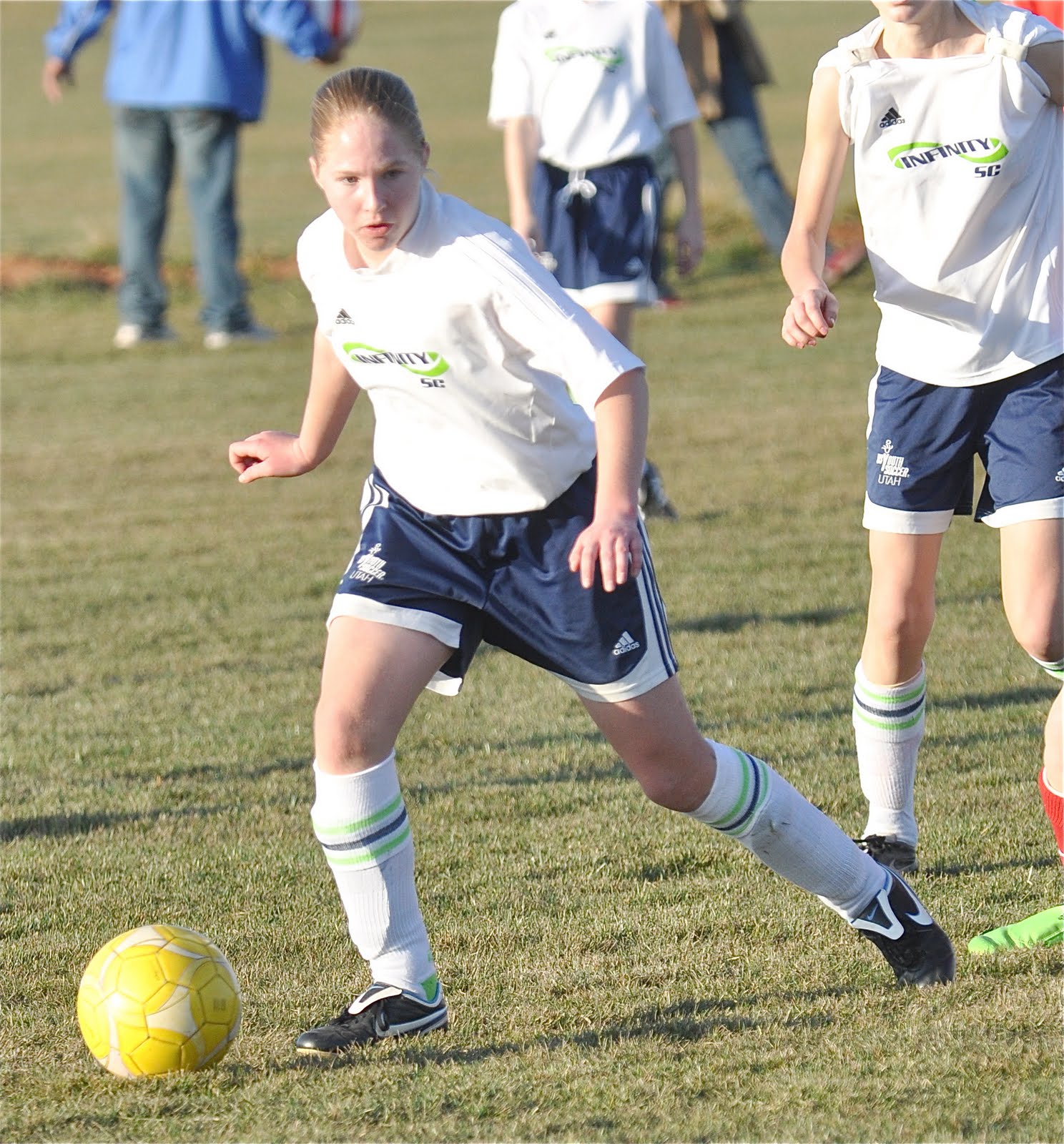
For a complete list of the girls and their coaches click here.
Pictured: Samantha Burton, Infinity SC '97 Premier, Coached By Sherri Dever plays for Mountain Crest High School as a Freshmen
Friday, July 8, 2011
Infinity is trying to change the soccer culture in Northern Utah...
In an article found in TELEGRAPH NEWSPAPER in England we find an article that expresses the same frustrations that Infinity SC feels as it tries to develop a player development philosophy in Northern Utah.
FA head of elite development Gareth Southgate has his work cut out trying to change the future for football
 A couple of years ago, the junior football club with which I was associated took an idea to our local youth league. It was that instead of seven-year-olds playing in seven-a-side matches with referees, baying parents on the touchline and results collated into league position, clubs should organise weekly friendlies at four-a-side.
The philosophy behind it was that without the pressure of parentally-imposed competitive structures, children might more enjoy their football, and, with many more touches of the ball available with fewer players on the pitch, develop their skills. There was nothing non-competitive about it: every child would want to win every game they played.
It would be immodest to claim it as our idea. That’s what they do in Holland, in Spain, in Germany, countries that seem to have a reasonable idea how to produce footballers. But when the proposal was raised, the wannabe Fergusons who made up the committee, those managing their little league sides in neatly pressed tracksuits with their initials on the chest, snorted derision.
“Kids want to see their name at the top of the league in the paper,” one said, to much agreement. In fact, most of the committee members thought it would be a better idea to institute competitive leagues for even younger age groups: “How else will they learn how to win?” When it came to a vote, ours was the only one cast in favour. We lost 23-1.
That, in microcosm, was English football : a latticework of self-interest. Never mind the wider good, what about my medals? And I thought of the episode when I heard that Gareth Southgate, the Football Association’s newly-appointed head of elite development, is touring the country, trying to persuade leagues to adopt a policy of small-sided games for young children. Good luck with that, I suggested when I met up with him earlier this week at the launch of the FA’s coaching licence scheme. There are oil tanker captains with easier jobs turning around their ships.
“Actually, there are signs of encouragement,” he said. “I meet lots of young coaches out there who are forward thinking. Yes, there are others set in their ways, but there’s an acknowledgment we have to catch up with the rest of the world. And to do that, one thing is for sure: we can’t carry on with what we’ve been doing.”
 Southgate’s task is not a minor one: it is to create a system which nurtures skill. Presently, among Englishmen aged 18 to 25, only a handful demonstrate ball-playing ability to match their European contemporaries. Actually, it is probably only Jack Wilshere who can hold his head up in international company. It is not much better below that: England’s Under-17s were this week evicted from the World Cup by – who else? – Germany.
Partly the issue lies with the Premier League academies, whose processes are under review. But in many ways the problems have been entrenched before young players arrive at elite clubs.
“The under-17s are at the end of the cycle,” Southgate said. “We need to concentrate right at the start of the process. There are so many steps along the way, there’s no scientific path. But I know this: if we don’t give them the right skill base from five until 10 [years of age] it won’t be there whatever you do thereafter.”
In order to do that, Southgate needs to do nothing less than effect an entire change of culture. Through a programme of coach education, he needs to persuade the self-interested parents and junior officials, vicariously living through their offspring, that they are not serving the best interest of the child. He needs to make things fun, with the emphasis on the development of skill. He needs, in short, to reverse the adultification of junior football.
“Parents and coaches have to understand that their child’s enjoyment, what they can learn from the game as people, in terms of team work, defeat and victory, is more important than anything,” he said.
“I do think we have a major cultural issue. We need to end the way in which the little kid is berated for losing the ball on the edge of the area, or the kid is applauded for hoofing it off the pitch.
“Until we alter that mindset then we’ve got a tough task if we want to produce skilful players. None of this will guarantee us a World Cup-winning team. But I’m dead certain that if we don’t change we’ll never have one.”
And as to the critique that the methodology he endorses promotes non-competitiveness, Southgate has a pertinent rebuttal.
“Look at the Williams sisters, they were brought up in an environment of positive reinforcement of hugs and love, they weren’t allowed to play in tournaments until they were 14. And no one could say they lack the will to win,” he said.
“We are trying to put in place ways to create an environment in which every kid – elite or not – can realise their potential within the game. To make football better for every child who plays it. If we don’t achieve anything else, that’s a worthwhile thing to do.”
Listening to Southgate it occurs to me that the FA seems to have done something unusual: made the right appointment. Only time will tell if anyone is prepared to listen to him.
FA head of elite development Gareth Southgate has his work cut out trying to change the future for football
 A couple of years ago, the junior football club with which I was associated took an idea to our local youth league. It was that instead of seven-year-olds playing in seven-a-side matches with referees, baying parents on the touchline and results collated into league position, clubs should organise weekly friendlies at four-a-side.
The philosophy behind it was that without the pressure of parentally-imposed competitive structures, children might more enjoy their football, and, with many more touches of the ball available with fewer players on the pitch, develop their skills. There was nothing non-competitive about it: every child would want to win every game they played.
It would be immodest to claim it as our idea. That’s what they do in Holland, in Spain, in Germany, countries that seem to have a reasonable idea how to produce footballers. But when the proposal was raised, the wannabe Fergusons who made up the committee, those managing their little league sides in neatly pressed tracksuits with their initials on the chest, snorted derision.
“Kids want to see their name at the top of the league in the paper,” one said, to much agreement. In fact, most of the committee members thought it would be a better idea to institute competitive leagues for even younger age groups: “How else will they learn how to win?” When it came to a vote, ours was the only one cast in favour. We lost 23-1.
That, in microcosm, was English football : a latticework of self-interest. Never mind the wider good, what about my medals? And I thought of the episode when I heard that Gareth Southgate, the Football Association’s newly-appointed head of elite development, is touring the country, trying to persuade leagues to adopt a policy of small-sided games for young children. Good luck with that, I suggested when I met up with him earlier this week at the launch of the FA’s coaching licence scheme. There are oil tanker captains with easier jobs turning around their ships.
“Actually, there are signs of encouragement,” he said. “I meet lots of young coaches out there who are forward thinking. Yes, there are others set in their ways, but there’s an acknowledgment we have to catch up with the rest of the world. And to do that, one thing is for sure: we can’t carry on with what we’ve been doing.”
 Southgate’s task is not a minor one: it is to create a system which nurtures skill. Presently, among Englishmen aged 18 to 25, only a handful demonstrate ball-playing ability to match their European contemporaries. Actually, it is probably only Jack Wilshere who can hold his head up in international company. It is not much better below that: England’s Under-17s were this week evicted from the World Cup by – who else? – Germany.
Partly the issue lies with the Premier League academies, whose processes are under review. But in many ways the problems have been entrenched before young players arrive at elite clubs.
“The under-17s are at the end of the cycle,” Southgate said. “We need to concentrate right at the start of the process. There are so many steps along the way, there’s no scientific path. But I know this: if we don’t give them the right skill base from five until 10 [years of age] it won’t be there whatever you do thereafter.”
In order to do that, Southgate needs to do nothing less than effect an entire change of culture. Through a programme of coach education, he needs to persuade the self-interested parents and junior officials, vicariously living through their offspring, that they are not serving the best interest of the child. He needs to make things fun, with the emphasis on the development of skill. He needs, in short, to reverse the adultification of junior football.
“Parents and coaches have to understand that their child’s enjoyment, what they can learn from the game as people, in terms of team work, defeat and victory, is more important than anything,” he said.
“I do think we have a major cultural issue. We need to end the way in which the little kid is berated for losing the ball on the edge of the area, or the kid is applauded for hoofing it off the pitch.
“Until we alter that mindset then we’ve got a tough task if we want to produce skilful players. None of this will guarantee us a World Cup-winning team. But I’m dead certain that if we don’t change we’ll never have one.”
And as to the critique that the methodology he endorses promotes non-competitiveness, Southgate has a pertinent rebuttal.
“Look at the Williams sisters, they were brought up in an environment of positive reinforcement of hugs and love, they weren’t allowed to play in tournaments until they were 14. And no one could say they lack the will to win,” he said.
“We are trying to put in place ways to create an environment in which every kid – elite or not – can realise their potential within the game. To make football better for every child who plays it. If we don’t achieve anything else, that’s a worthwhile thing to do.”
Listening to Southgate it occurs to me that the FA seems to have done something unusual: made the right appointment. Only time will tell if anyone is prepared to listen to him.
Wednesday, June 22, 2011
Soccer America: Youth Insider
Former U-17 coach Roy Rees: USA should be further along
article can be viewed at www.SoccerAmerica.com
By Mike Woitalla
How many players on the U.S. team currently competing at the U-17 World Cup will make a significant impact on the full national team?
Judging from the average of the previous 13 U.S. teams that have competed at each of the biennial world championships since 1985, the answer would be one.
Roy Rees coached the USA at four U-17 World Cups, from 1987 through 1993. He guided the young Americans to historic victories over Brazil in 1989 and Italy in 1991. After the USA, led by Claudio Reyna, beat Brazil, 1-0, in 1989, Brazil’s coach Homero Cavalheiro said, “The United States deserved to win today. They were better as a team; they were better individually.”
Asked how he imagined the future of American soccer two decades ago, Rees says, “I would have expected it to be further along than it is now. They've done well but could have done much better.
"They have developed a whole bunch of very average players but not the great players you need to get that little bit extra. There's a lack of creative players."
 Mike Burns and John O'Brien, who played for Rees in the 1987 and 1993 tournaments, were also among the U-17 alums who had the most success with the full national team.
Rees was succeeded by Glenn Myernick (1995), Jay Miller (1997), John Ellinger (1999, 2001, 2003), John Hackworth (2005, 2007) and Wilmer Cabrera (2009, 2011).
Ellinger's 1999 team, which was the first that went into full-time residency in Bradenton, Fla., finished fourth and remains the only squad to win a knockout stage game. It included Landon Donovan, DaMarcus Beasley, Oguchi Onyewu and Bobby Convey. That class proved to be an aberration.
Miller’s 1997 squad included Taylor Twellman and Danny Califf, who went on to long pro careers but had limited success with the full national team. Ellinger’s 2001 and 2003 squads included Eddie Johnson and Jonathan Spector, respectively.
Hackworth’s 2005 team included Jozy Altidore and Neven Subotic, now one of the top defenders in the German Bundesliga, but he plays his national team ball for Serbia.
Rees, a Welshman who served as an English FA staff coach and worked for FIFA as an international coaching instructor before taking over the U.S. U-17s, cites many reasons why the USA hasn't made more profound progress in producing exceptional players. Topping the list is an emphasis on athleticism rather than on skill and understanding the game.
"America had the reputation of being better athletically than everyone else, because at the Olympics they ran faster, were stronger, and threw things farther,” he says. “Those are things that have nothing to do with soccer. At the youth level, big, strong and physical may win games. But the smaller players develop skills to combat the big and the physical, and when they get the growth they’re the ones who get the results."
He also warns of the perils of advocating an orthodox approach to player development:
"It was, 'Coach this way, or get out.' There are different ways of developing players, which is obvious when you see how great players have emerged from different countries."
He says that the insight into the game that great players acquire is something that they develop naturally when they're young, not from being told how to play, but by being given the freedom figure the game out.
“What matters is being able to perceive the game, to predict what happens next," says Rees. "They need to be placed in a situation where they can see it for themselves rather than having it laid out for them. That needs to happen at the youngest levels. They need to be allowed to express themselves and not be tied to the coach’s instructions, or they’ll play like robots.”
Now retired and living in Southern California, Rees is watching this U.S. U-17 team on TV. Not judging it by the scorelines, but whether there are within the group some players with that little bit extra that hints of greatness.
* * * *
 The USA opened its U-17 World Cup campaign with a 3-0 win over the Czech Republic on Sunday with goals by Alejandro Guido and Esteban Rodriguez and late sub Alfred Koroma. In their second Group D game, the Americans face Uzbekistan on Wednesday (4 pm ET, Galavision, ESPN3.com).
Uzbekistan lost its opener, 4-1, to New Zealand, which got a hat trick by Stephen Carmichael. Carmichael, making his first start for the Kiwis, hadn’t been part of the squad during qualifying nor for a pre-tournament tour to Qatar.
Go HERE for U-17 World Cup results and schedule.
(Mike Woitalla, the executive editor of Soccer America, coaches youth soccer for East Bay United in Oakland, Calif. His youth soccer articles are archived at YouthSoccerFun.com.)
article can be viewed at www.SoccerAmerica.com
By Mike Woitalla
How many players on the U.S. team currently competing at the U-17 World Cup will make a significant impact on the full national team?
Judging from the average of the previous 13 U.S. teams that have competed at each of the biennial world championships since 1985, the answer would be one.
Roy Rees coached the USA at four U-17 World Cups, from 1987 through 1993. He guided the young Americans to historic victories over Brazil in 1989 and Italy in 1991. After the USA, led by Claudio Reyna, beat Brazil, 1-0, in 1989, Brazil’s coach Homero Cavalheiro said, “The United States deserved to win today. They were better as a team; they were better individually.”
Asked how he imagined the future of American soccer two decades ago, Rees says, “I would have expected it to be further along than it is now. They've done well but could have done much better.
"They have developed a whole bunch of very average players but not the great players you need to get that little bit extra. There's a lack of creative players."
 Mike Burns and John O'Brien, who played for Rees in the 1987 and 1993 tournaments, were also among the U-17 alums who had the most success with the full national team.
Rees was succeeded by Glenn Myernick (1995), Jay Miller (1997), John Ellinger (1999, 2001, 2003), John Hackworth (2005, 2007) and Wilmer Cabrera (2009, 2011).
Ellinger's 1999 team, which was the first that went into full-time residency in Bradenton, Fla., finished fourth and remains the only squad to win a knockout stage game. It included Landon Donovan, DaMarcus Beasley, Oguchi Onyewu and Bobby Convey. That class proved to be an aberration.
Miller’s 1997 squad included Taylor Twellman and Danny Califf, who went on to long pro careers but had limited success with the full national team. Ellinger’s 2001 and 2003 squads included Eddie Johnson and Jonathan Spector, respectively.
Hackworth’s 2005 team included Jozy Altidore and Neven Subotic, now one of the top defenders in the German Bundesliga, but he plays his national team ball for Serbia.
Rees, a Welshman who served as an English FA staff coach and worked for FIFA as an international coaching instructor before taking over the U.S. U-17s, cites many reasons why the USA hasn't made more profound progress in producing exceptional players. Topping the list is an emphasis on athleticism rather than on skill and understanding the game.
"America had the reputation of being better athletically than everyone else, because at the Olympics they ran faster, were stronger, and threw things farther,” he says. “Those are things that have nothing to do with soccer. At the youth level, big, strong and physical may win games. But the smaller players develop skills to combat the big and the physical, and when they get the growth they’re the ones who get the results."
He also warns of the perils of advocating an orthodox approach to player development:
"It was, 'Coach this way, or get out.' There are different ways of developing players, which is obvious when you see how great players have emerged from different countries."
He says that the insight into the game that great players acquire is something that they develop naturally when they're young, not from being told how to play, but by being given the freedom figure the game out.
“What matters is being able to perceive the game, to predict what happens next," says Rees. "They need to be placed in a situation where they can see it for themselves rather than having it laid out for them. That needs to happen at the youngest levels. They need to be allowed to express themselves and not be tied to the coach’s instructions, or they’ll play like robots.”
Now retired and living in Southern California, Rees is watching this U.S. U-17 team on TV. Not judging it by the scorelines, but whether there are within the group some players with that little bit extra that hints of greatness.
* * * *
 The USA opened its U-17 World Cup campaign with a 3-0 win over the Czech Republic on Sunday with goals by Alejandro Guido and Esteban Rodriguez and late sub Alfred Koroma. In their second Group D game, the Americans face Uzbekistan on Wednesday (4 pm ET, Galavision, ESPN3.com).
 Uzbekistan lost its opener, 4-1, to New Zealand, which got a hat trick by Stephen Carmichael. Carmichael, making his first start for the Kiwis, hadn’t been part of the squad during qualifying nor for a pre-tournament tour to Qatar.
Go HERE for U-17 World Cup results and schedule.
(Mike Woitalla, the executive editor of Soccer America, coaches youth soccer for East Bay United in Oakland, Calif. His youth soccer articles are archived at YouthSoccerFun.com.)
Subscribe to:
Posts (Atom)
